PCIe Grandmaster Clock

Open Timecard Mini 3.0

Synchronise · Deploy · Distribute

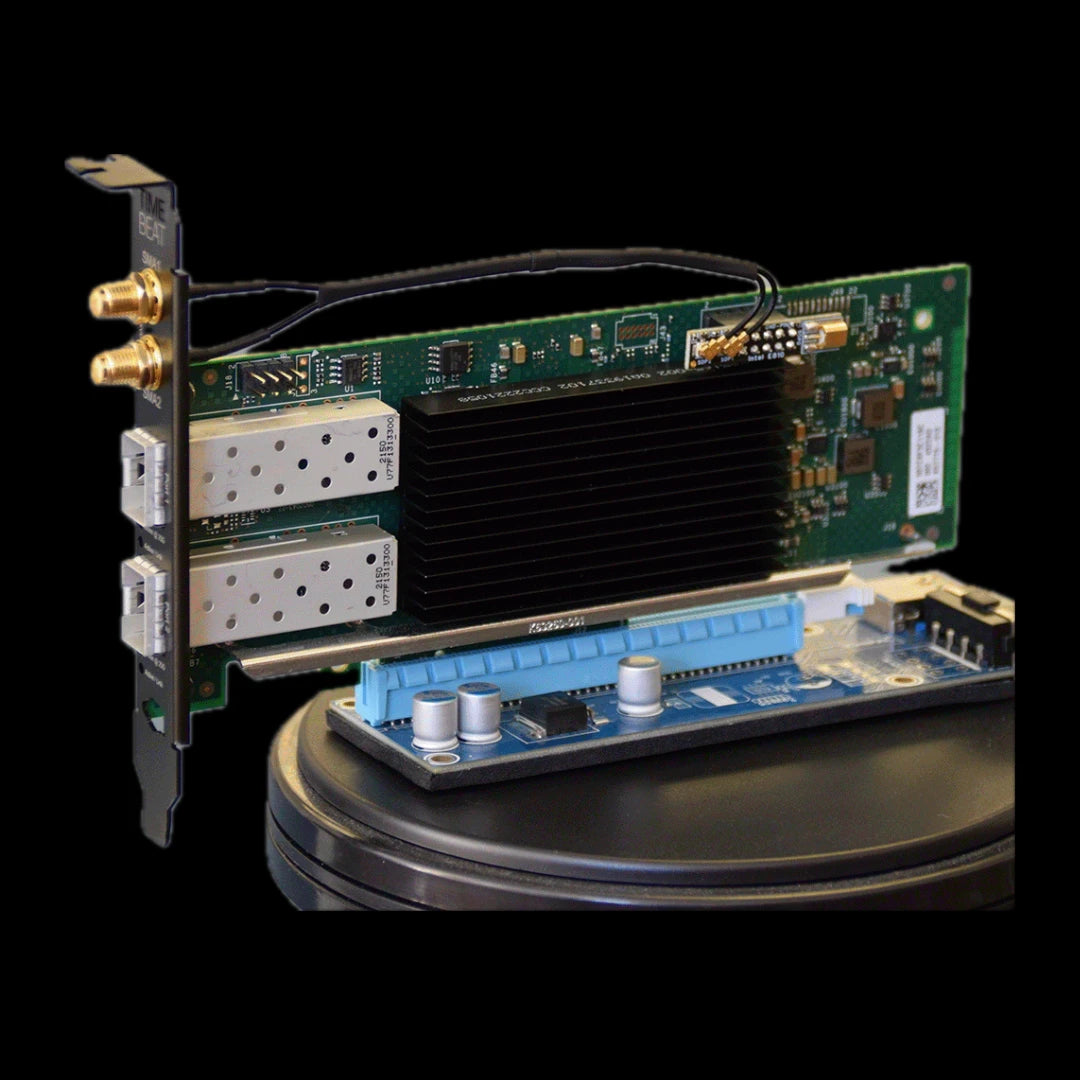
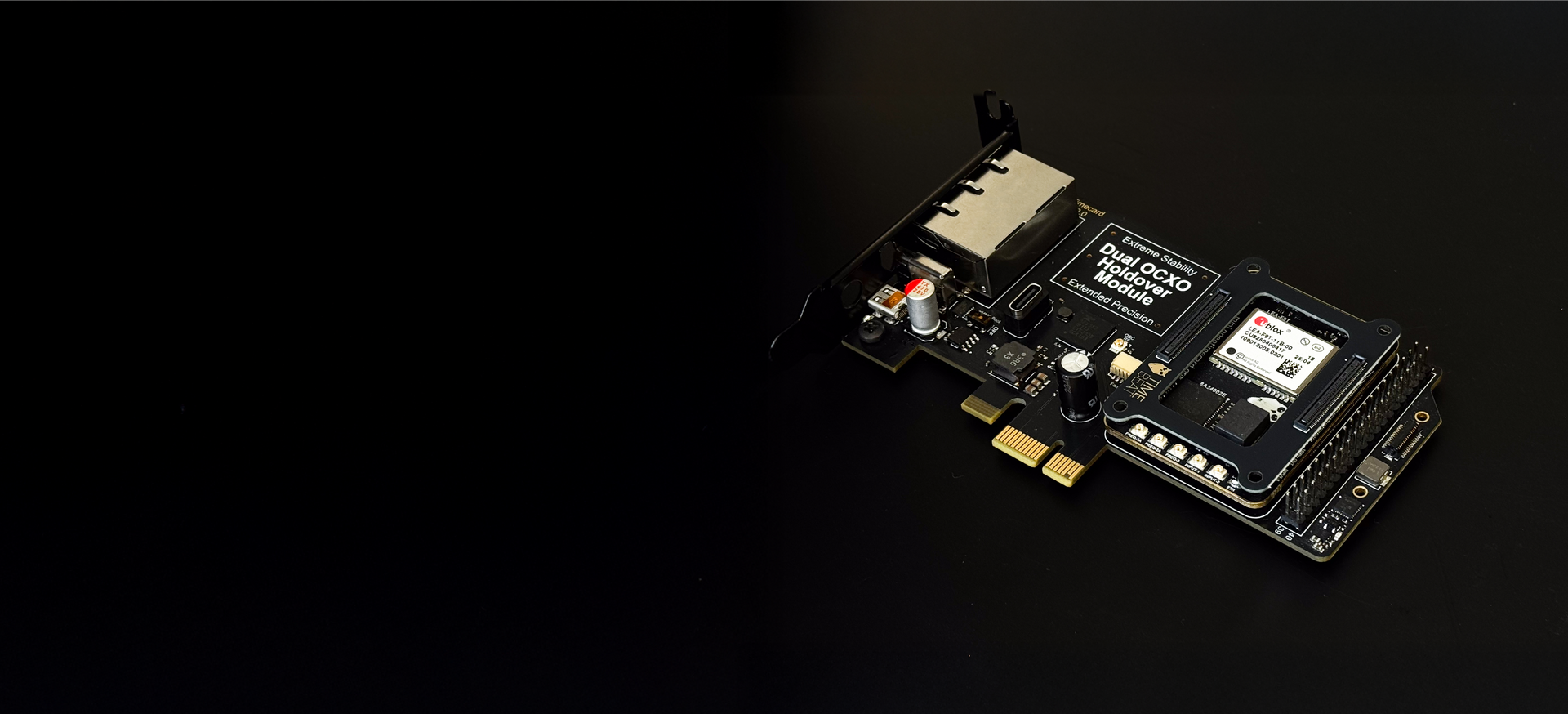
The Open Time Appliance Mini, re-engineered as a PCIe card. Same multi-band GNSS receiver, same DOCXO oscillator, same software stack, same protocol coverage — host-powered, no rack unit added. Configure your edition below.

From 

What It Is

Grandmaster Clock — PCIe Form Factor

Take the proven Open Time Appliance Mini platform — multi-band GNSS, DOCXO holdover, full PTP/NTP profile coverage, TimeBeat's jitter-attenuation engine — and drop it onto a PCIe baseboard. Three roles in one card: primary edge grandmaster, resilient holdover source, or precision reference for commissioning and audit.

≤5ns Accuracy to UTC
1.5µs / 24h DOCXO Holdover · GNSS-denied
±4ns Time Pulse Jitter
L1/L2/L5 Constellations · Bands
OSNMA Authenticated GNSS · PT edition

Deployment modes

One card. Three roles.

The Mini 3.0 is more than a single-use timing source. It can anchor a live network, protect timing through GNSS disruption, or travel as a precision reference for commissioning and troubleshooting.

Primary Edge Grandmaster

Deploy grandmaster-class PTP and NTP timing inside the host that already serves the workload — DU/CU hosts, trading servers, media gateways, substation gateways. No second appliance, no second cable run, no second SLA to defend.

Resilient Holdover Engine

With the DOCXO upgrade, the Precision Timing edition holds 1.5µs for 24 hours after GNSS loss — parts-per-trillion stability through jamming, spoofing, antenna fault or rooftop disruption. Pair with the host's UPS for true power-and-time resilience.

Precision Timing Reference

Slot into a lab or test server to provide a stable, traceable UTC reference for acceptance testing, regulator audits and PTP fault-isolation. Pair with Sync Insight for 12+ months of high-resolution clock telemetry — every offset, every drift event, every Allan-deviation curve.

Trusted Timing

Five constellations. Three bands. Authenticated.

GPS, Galileo, GLONASS, BeiDou and QZSS tracked simultaneously across L1, L2 and L5. Multi-band reception eliminates ionospheric delay error and gives the receiver enough redundancy to ride out single-constellation jamming. The Precision Timing edition adds Galileo OSNMA — cryptographic authentication of the navigation message, signed by the European GNSS Service Centre. Spoofed signals are rejected before the timing engine ever sees them.

Precision Timing Edition · Galileo OSNMA

Authenticated navigation — not just received.

Most GNSS receivers accept any signal that looks valid. The Precision Timing edition goes further: Galileo OSNMA cryptographically verifies the navigation message before it is used, ensuring the timing reference itself cannot be spoofed or silently corrupted.

Signal Authenticity

OSNMA cryptographically verifies that Galileo navigation data was signed by the European GNSS Service Centre — before the timing engine acts on it. Spoofed signals are rejected at source.

Resilient Timing Decisions

When OSNMA-authenticated Galileo disagrees with unauthenticated sources, the ensemble drops the suspect inputs and rides on the authenticated subset — keeping the network locked through spoofing and meaconing attacks.

Better Fit for Critical Sites

Designed for telecom cell sites, electricity substations, broadcast plant, defence-adjacent infrastructure and any deployment where GNSS denial is a real-world risk — not a theoretical one.

GNSS Powered Multi-constellation L1/L2/L5
Galileo OSNMA Authenticated GNSS (PT edition)
±5 ppb Daily OCXO stability

Software-Defined Timing

A clean clock, not just a fast one.

Multi-band GNSS gives you accurate time. TimeBeat's jitter-attenuation engine gives you stable time — filtering network noise, asymmetric path delay and oscillator phase noise from every timestamp, in real time. Sub-nanosecond residual phase noise to every downstream consumer, on the same software stack that powers our full Open Time Appliance platform.

Network-noise filtering

Continuous Kalman-grade filtering of incoming PTP and GNSS timestamps strips packet-delay variation, asymmetric path delay and burst jitter before they reach your downstream clocks.

Oscillator phase-noise control

Sub-nanosecond OCXO/DOCXO tuning compensates for short-term phase noise and long-term aging. The clock you serve is cleaner than the clock you receive.

Clock Ensemble ready

Fuse GNSS with upstream PTP, White Rabbit and local oscillators using TimeBeat's BIPM-style ensemble. Outliers are detected statistically and dropped — no phase jumps, no manual intervention.

Open Timecard Mini 3.0 PCIe card

Direct timing distribution

One card. Your server becomes the grandmaster.

No external distribution box, no second cable run, no separate appliance in the rack. Half-height and full-height brackets ship in every order — three cards fit a single 1RU server for high-density timing-as-fabric deployments.

5ns

Absolute Accuracy

±4ns

Time Pulse Jitter

1.5µs

OCXO Holdover · 8hr

Find your precision

Three Tiers of Precision

All three editions share the same Mini 3.0 baseboard, software stack, and full protocol profile support. The decision comes down to accuracy, oscillator performance, and holdover requirements.

Precision Timing

Flagship

Precision Timing

  • Accuracy: <5ns to UTC
  • OCXO holdover: 1.5µs / 8hr (standard)
  • DOCXO upgrade: 1.5µs / 24hr (+£295)
  • GPS + GAL + GLO + BDS + QZSS · L1/L2/L5
  • Galileo OSNMA authenticated GNSS
  • 10MHz + dual programmable Freq-A/B outputs

From £799.95

Precision Timing Lite

Best Value

Precision Timing Lite

  • Accuracy: ≤10ns to UTC
  • No OCXO holdover
  • GPS + GAL + BDS · L1/L2/L5 multi-band
  • ±1ppb stability (-40→85°C)
  • Every PTP / NTP profile included · ideal hot-standby pair

From £285.95

Essential

Entry

Essential

  • Accuracy: 30ns to UTC
  • L1 / L5 GNSS, auto-select
  • All PTP / NTP profiles included

From £75.95

Specification Precision Timing Lite Essential
Timing accuracy <5ns ≤10ns 30ns
OCXO holdover (standard) 1.5µs / 8hr
DOCXO holdover (upgrade) 1.5µs / 24hr
GNSS bands L1 / L2 / L5 L1 / L2 / L5 L1 / L5
GNSS Constellations GPS + GAL + GLO + BDS + QZSS GPS + GAL + BDS GPS + GAL
Galileo OSNMA (authenticated GNSS) Yes Firmware upgradable
Stability range ±1ppb (-55→105°C) ±1ppb (-40→85°C)
Frequency outputs 10MHz + dual programmable

Every edition shares the same Mini 3.0 base board. PTP profiles, NTP, PPS and software stack are identical across all three.

PCIe Card or Mini Box?

Same engine. Pick the form factor that fits your deployment.

The Open Timecard Mini 3.0 (this product) and the Open Time Appliance Mini ship the same multi-band GNSS, DOCXO, software stack and protocol coverage. The decision is form factor, power and density — not timing performance.

  Open Timecard Mini 3.0 (PCIe) Open Time Appliance Mini (box)
Form factor Half- or full-height PCIe card 144 × 82 × 44 mm desktop / shelf box
GNSS receiver L1/L2/L5 multi-band, up to 5 constellations Identical
Oscillator / holdover OCXO 8 h std · DOCXO 24 h upgrade Identical
PTP / NTP profile coverage Every major profile Identical
Power Host PCIe — no DC supply needed 30 W barrel jack + battery
Outage survival Inherits host UPS / redundant PSU On-board battery pack
Density Up to 3 cards in a 1RU server One unit per shelf or desk
Field portability Server-resident — not portable Carry-on portable, battery-powered
Best fit DU/CU hosts · trading servers · dense edge · ST 2110 plant Field test · OB trucks · audit / commissioning · portable reference
Starting price From £225 From £1,495

Technical Details

Specifications

Key Timing Performance

5ns

Absolute Accuracy

2.5ns

Differential Timing

±4ns

Time Pulse Jitter

±5ppb

OCXO Daily Stability

SpecificationDetail
GNSS receiveru-blox multi-band — L1/L2/L5 (PT & Lite), L1/L5 (Essential). −167 dBm tracking sensitivity, 26 s cold start.
ConstellationsPT: GPS + GAL + GLO + BDS + QZSS · Lite: GPS + GAL + BDS · Essential: GPS + GAL
GNSS authenticationGalileo OSNMA cryptographic signal authentication (Precision Timing only)
PTP / NTP outputsAll major profiles — Default, Enterprise, IEC 61850-9-3, IEEE C37.238, ITU-T G.8265/G.8275, SMPTE 2059-2, AES67/RAVENNA
Oscillator (PT, standard)OCXO — 1.5µs / 8hr holdover, sub-picosecond tuning
Oscillator (PT, optional upgrade)DOCXO — 1.5µs / 24hr holdover, parts-per-trillion stability
Frequency outputs (PT only)10MHz fixed + dual programmable Freq-A / Freq-B (1Hz–1GHz)
Antenna connectorSMA — active multi-band GNSS antenna recommended
Host interfacePCIe IO — host-powered, no DC barrel jack required
BracketsHalf-height/ Full-height or Both bracket
SoftwareTimeBeat software stack — identical across all Mini 3.0 editions and the Open Time Appliance Mini box.
Jitter attenuationReal-time Kalman-grade filtering of network and oscillator phase noise. Sub-nanosecond residual phase noise delivered to downstream consumers.
Telemetry1-second-resolution clock metrics streamed to Sync Insight (optional) — 12+ months retention, Allan-deviation analytics, MiFID II / CAT compliance reports.
Operating temperature0 °C to +50 °C operating, −55 °C to +105 °C storage. RoHS compliant.

Bracket I/O & Host Interface

Bracket I/O

  • SMA Antenna InActive GNSS
  • SMA 1PPS Out1Hz pulse
  • SMA 10MHz OutPT only
  • SMA Freq-A / Freq-B Out1Hz–1GHz, PT only
  • Status LEDsLock + GNSS state

Host Interface

  • PCIe IO SlotStandard, host-powered
  • PHC SyncDisciplines host NIC for PTP/NTP distribution
  • Brackets IncludedHalf-height + full-height
  • Driver / OSLinux, Timebeat stack
  • Not IncludedEnclosure, battery, UPS — host provides power. Need a portable, battery-backed unit? See Open Time Appliance Mini.

10MHz and Freq-A/Freq-B SMA outputs are populated only on the Precision Timing edition. PTP and NTP are delivered through the host server's NIC, disciplined by the card's Precision Hardware Clock.

Protocol Support

Comprehensive PTP & NTP Capabilities

A flexible timing endpoint for heterogeneous networks, with support spanning enterprise PTP, utility, broadcast, telecom, NTP, PPS, and frequency distribution — no licence fees, no add-ons, out of the box.

Default Profiles

  • Default E2E — IEEE 1588-2008
  • Default P2P — IEEE 1588-2008
  • Enterprise PTP (Draft)

Power Profiles

  • IEEE C37.238-2011
  • IEEE C37.238-2017
  • IEC/IEEE 61850-9-3 Power Utility

Broadcast Profiles

  • SMPTE ST 2059-2
  • AES67 / RAVENNA
  • IEEE 802.1AS

Telecom Profiles

  • ITU-T G.8265.1
  • ITU-T G.8275.1
  • ITU-T G.8275.2

PTP Versions

  • PTPv2.1 (IEEE 1588-2019)
  • PTPv2 (IEEE 1588-2008)

Additional Protocols

  • NTP (Network Time Protocol)
  • PPS (1Hz pulse per second)
  • Frequency distribution (PT only)

IEEE 1588 Clock Modes

Unicast Master
Multicast Master
Unicast Slave
Multicast Slave

Contact form


How to Set Up Your Timebeat Timecard Mini